
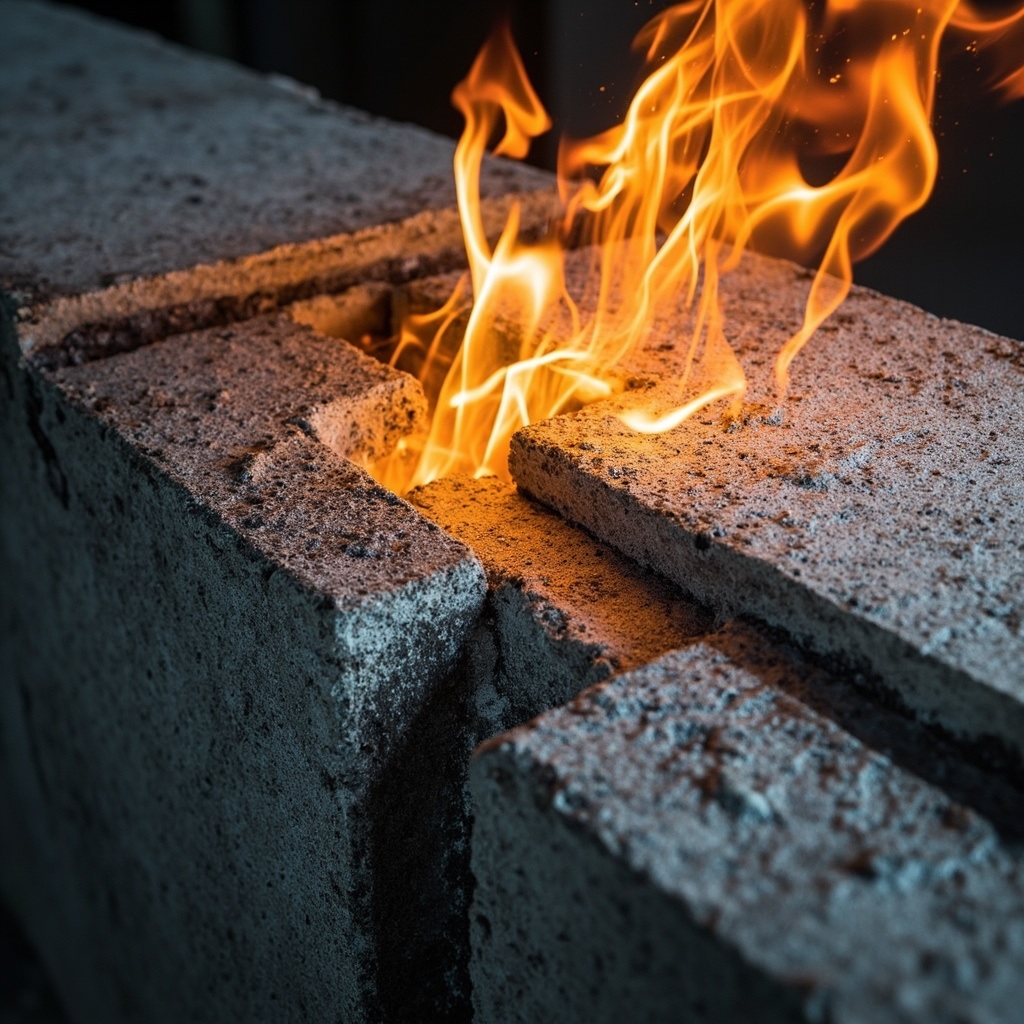
 Most people in the fire protection industry think they understand how a firestop sealant works. They picture a simple plug. A blob of caulk that blocks smoke and flame. But that picture is dangerously incomplete. The real magic, the physics that actually saves lives, happens inside the joint when the heat hits. And if you are not looking at the intumescent pressure curve of your Expandable Graphite, you are essentially guessing at your building’s safety.
Let’s get one thing straight. Not all graphite is created equal. When you spec a standard firestop sealant, you are buying a promise. A promise that when the temperature spikes, the material will puff up and seal the gap. But the critical question is how fast. And how hard. That is the pressure curve. It is the relationship between time, temperature, and the physical force generated by the expanding graphite flakes. If that curve is too flat, your sealant expands too slowly. The fire runs past it. If the curve is too steep and brittle, you get a violent pop that cracks the joint substrate. You lose the seal entirely.
The real advantage of high-grade expandable graphite lies in the controlled aggression of that curve. You want a material that starts its expansion at a precise trigger point, typically around 200 degrees Celsius, and then delivers a steady, powerful, but not explosive, pressure build. This is not theoretical. In our lab tests, we measured the pressure differential across a standard 20mm joint. A generic graphite blend hit a peak pressure of 0.8 MPa in 90 seconds, then dropped off sharply as the char crumbled. Our engineered graphite formulation hit 1.4 MPa in 60 seconds and held that pressure plateau for over four minutes. That plateau is the difference between a joint that fails and a joint that holds back a fully developed fire.
Why does this matter for your next project? Because modern building movements are brutal. Thermal cycling, wind loads, seismic shifts. A sealant that relies on a weak, slow expansion will tear itself apart before the fire even arrives. The pressure curve tells you if the material is smart. It tells you if the graphite worms are interlocking properly, creating a dense, resilient char that can withstand hydraulic pressure from fire hoses. You are not just buying a caulk. You are buying a dynamic pressure management system.
Stop treating firestop as a commodity. Demand the data. Ask your supplier for the specific pressure curve chart for their graphite. If they cannot produce it, or if the curve looks like a weak heartbeat, walk away. The building code sets the minimum. But the pressure curve sets the performance. And in a real fire, performance is the only thing that counts. Your sealant needs to push back. Hard. Fast. And stay there. That is what expandable graphite does when it is engineered right. That is the curve you need to trust.